Most songs don't need a bridge. But the ones that have a great one? You remember them differently.
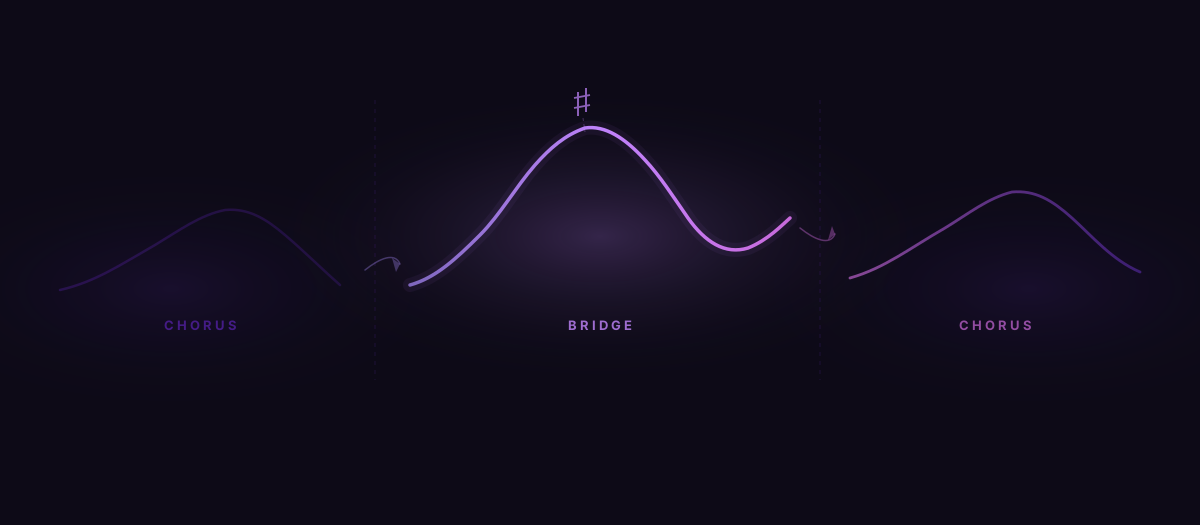
A bridge is the moment the song steps outside of itself. It changes something, the chord progression, the perspective, the rhythm, the melody, and when the chorus comes back, it means more than it did before.
That's the job. Not filler. Not decoration. A shift that earns the return.
Why bridges exist
Verse-chorus structures are built on repetition. That's their power. But repetition has a ceiling, after the second chorus, the listener already knows what's coming. The ear starts to disengage.
A bridge breaks that pattern on purpose. It introduces enough unfamiliarity to reset the listener's attention, so that when the chorus returns, it feels like a payoff instead of a loop.
Think of it like a conversation. You've been making the same point for two minutes. A bridge is the moment you pause, look at it from a completely different angle, and then come back. Now the point lands.
Rule one: change at least two things
A bridge that only changes the lyrics but keeps the same melody, chords, and rhythm doesn't feel like a bridge. It feels like another verse.
Pick at least two of these to change:
- Chords, move to a new harmonic area. If your song lives in I–V–vi–IV, try starting the bridge on the vi or the IV. Even a small shift feels dramatic after two choruses.
- Melody, change the range. If your verses and choruses sit in the mid-range, push the bridge higher or pull it lower. Give the voice somewhere new to go.
- Rhythm, shift the phrasing. If the rest of the song has tight, rhythmic lyrics, open the bridge up with longer, more spacious lines. Or vice versa.
- Perspective, change who's talking, or when, or how. A song written in first person can shift to second person in the bridge. A present-tense song can flash back. A "you and me" song can suddenly zoom out to "everyone."
Two changes is usually enough. Three is powerful. Four might make the bridge feel disconnected, be careful.
Start from the emotion you haven't said yet
Here's a question that almost always unlocks a bridge: what hasn't the song said yet?
If the verses and chorus are about missing someone, the bridge might be about admitting you caused the distance. If the song is angry, the bridge might be the sadness underneath. If the song is confident, the bridge might be the doubt.
The bridge is where honesty deepens. It's the part of the song where the narrator drops the performance and says the thing that's harder to say.
That's why bridges are often quieter, not because they have to be, but because vulnerability tends to pull the energy inward before it pushes back out.
Keep it short
A bridge should be four to eight lines. That's it.
The most common mistake is writing a bridge that's too long. It overstays its welcome, the tension plateaus, and the return to the chorus loses impact.
Think of a bridge like holding your breath. The chorus is the exhale. If you hold too long, the exhale isn't relief, it's just gasping.
Four lines is often perfect. Enough to shift, not enough to settle.
Build toward the return
The best bridges don't just stop, they point back. The last line of the bridge should create an almost physical pull toward the chorus.
Ways to do this:
- Melodic rise, end the bridge on a note that wants to resolve, right where the chorus begins
- Lyrical setup, make the last bridge line incomplete or unanswered, so the chorus answers it
- Dynamic build, gradually increase intensity (add instruments, raise the vocal) so the chorus arrives like a wave breaking
- Silence, strip everything away for a beat. The pause makes the chorus entrance feel enormous
Listen to the bridge in "Someone Like You" by Adele. The line "Nothing compares, no worries or cares" builds tension that the final chorus releases. That's the mechanism.
The "zoom out" technique
If you're stuck, try this: take whatever your chorus is about and zoom out.
- Chorus about a breakup → bridge about what love means in general
- Chorus about a night out → bridge about why you needed to escape
- Chorus about ambition → bridge about what you're afraid of losing
Zooming out gives you emotional altitude. It reframes the song's core idea without contradicting it, and it gives the listener a new lens for the final chorus.
Test it by skipping it
Record a rough version of your song with and without the bridge. Listen to both. If the version without the bridge feels complete, your bridge isn't doing enough work. If the version with the bridge makes the last chorus feel bigger, you've written a good one.
A bridge should feel necessary in retrospect, like the song was always waiting for that moment.
Not every song needs a bridge. But if yours feels like it's running out of momentum after the second chorus, that's the bridge's job: to take the listener somewhere unexpected so the return home means something.
If your bridge lyrics are the part giving you trouble, GenLyr can help, describe the emotional shift you want, and it generates lyrics that contrast with your existing verses and chorus. It's a fast way to find the perspective change your song is missing.
If you're still working on the chorus itself, how to write a chorus people remember covers that ground. And if you want the full picture of how all these sections fit together, how to structure a song for beginners is a good starting point.